


Cartesian Coordinates
(KS2, Year 6)
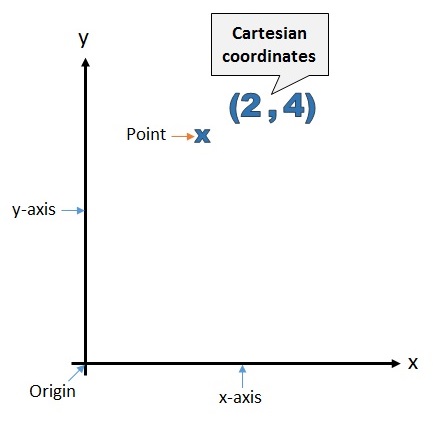 Don't forget: a graph has a pair of axes: the horizontal axis is called the x-axis and the vertical axis is called the y-axis. They meet at the origin. We can plot points, lines and curves on a graph.
How Do Cartesian Coordinates Work?
Cartesian coordinates work by measuring how far the point is from the origin.-
First you measure how far across the point is (in the horizontal direction) by measuring how far along the x-axis it is. This is called the x-coordinate.
 The point above is 2 units along the x-axis so its x-coordinate is 2.
Note: The x-axis is labelled with numbers (0, 1, 2, 3...) so you can measure how far across the point is.
The point above is 2 units along the x-axis so its x-coordinate is 2.
Note: The x-axis is labelled with numbers (0, 1, 2, 3...) so you can measure how far across the point is.
-
Then you measure how far up the point is (in the vertical direction) by measuring how far up the y-axis it is. This is called the y-coordinate.
 The point above is 4 units along the y-axis so its y coordinate is 4.
Note: The y-axis is labelled with numbers (0, 1, 2, 3...) so you can measure how far up the point is.
The point above is 4 units along the y-axis so its y coordinate is 4.
Note: The y-axis is labelled with numbers (0, 1, 2, 3...) so you can measure how far up the point is.
-
The x-coordinate (2) and the y-coordinate (4) are then written in brackets, separated by a comma. The x-coordinate is on the left, the y-coordinate is on the right.
.jpg)
Cartesian Coordinates in General
In general, we write Cartesian coordinates as: x is the x-coordinate.
y is the y-coordinate.
x and y can taken any number (whole or fraction, positive or negative).
x is the x-coordinate.
y is the y-coordinate.
x and y can taken any number (whole or fraction, positive or negative).
What's in a Name?
Cartesian coordinates are named after the French philospher, mathematician and writer, René Descartes. Descartes is famous for the phrase "Cogito ergo sum" - 'I think therefore I am'.
In mathematics, Descartes laid down many of the conventions on notation we use today.
In algebra, he was the first to call unknowns x, y and z, and knowns a, b and c. If you still get confused having letters stand in for numbers, blame Descartes!
Descartes is famous for the phrase "Cogito ergo sum" - 'I think therefore I am'.
In mathematics, Descartes laid down many of the conventions on notation we use today.
In algebra, he was the first to call unknowns x, y and z, and knowns a, b and c. If you still get confused having letters stand in for numbers, blame Descartes!
Four Quadrants
x-coordinates and y-coordinates can be positive and negative. This means there are four quadrants made by the two axes.
Beware
Don't Mix Up The Coordinates
An easy mistake to make is to mix up the x and y coordinates.
- The coordinate on the left is the x-coordinate. It describes how far along the x-axis, or how far across, the point is. Remember, x is a cross!
- The coordinate on the right is the y-coordinate. It describes how far up the y-axis, or how far up, the point is.

This page was written by Stephen Clarke.
Worksheet
This test is printable and sendable


