


Finding the X-Intercepts of a Function
(KS4, Year 10)
The Lesson
The x-intercepts of a function are found where the graph of a function crosses the x-axis on a pair of Cartesian coordinate axes.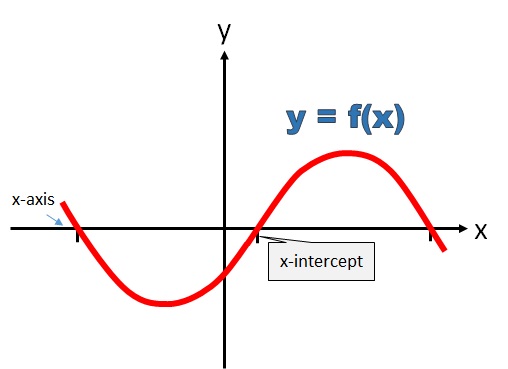
How to Find the X-intercepts of a Function
The x-intercepts of a function f(x) is found by finding the values of x which make f(x) = 0.=0.jpg) Write f(x) = 0, and solve for x to find the x-intercepts of a function.
The method for solving for x will depend on the type of function (linear, quadratic, or trigonometric etc).
Write f(x) = 0, and solve for x to find the x-intercepts of a function.
The method for solving for x will depend on the type of function (linear, quadratic, or trigonometric etc).
Why Does This Work?
Solving f(x) = 0 uses functional notation (see Note) to express the following idea. The function plotted on the graph is y = f(x). That is, the output of the function at each input x is assigned to y. (The input is the x-coordinate and we write the output as the y-coordinate). The x-intercepts are the ouput of the function at the x-axis. Along the x-axis, the value of y is 0. The output f(x) (which is plotted as y) of the function equals 0. The image below shows what we mean:
A Real Example of How to Find the X-intercepts of a Function
Finding the x-intercepts of a function is easy.Question
What are the x-intercepts of the function f(x) = 2x − 4?Step-by-Step:
1
Write the function equal to 0, f(x) = 0.
f(x) = 2x − 4 = 0
2
Find the value of x that solves the equation.
What Type of Equation Is It?
This is a linear equation.How Do We Solve It?
Rearrange the equation to find "x = ".| 2x − 4 = 0 | |
| 2x − 4 + 4 = 0 + 4 | Add 4 to both sides |
| 2x = 4 | |
| 2x ÷ 2 = 4 ÷ 2 | Divide both sides by 2 |
| x = 2 |
Answer:
The x-intercept of f(x) = 2x − 4 is 2.
Another Real Example of How to Find the X-intercepts of a Function
Question
What are the x-intercepts of the function f(x) = x2 + 4x + 3?Step-by-Step:
1
Write the function equal to 0, f(x) = 0.
f(x) = x2 + 4x + 3 = 0
2
Find the value of x that solves the equation.
how to solve quadratic equations using factoring
What Type of Equation Is It?
This is a quadratic equation.How Do We Solve It?
Factor the quadratic equation into two brackets. Set each bracket to equal 0 and find "x = ".| x2 + 4x + 3 = 0 | |
| (x + 1)(x + 3) = 0 | Find two numbers that multiply to make the constant term (3) and add to the coefficient of x (4) 1 and 3 do this. Put them in brackets added to x |
| x + 1 = 0 ⇒ x = −1 | Equate 1st bracket to 0 and solve |
| x + 3 = 0 ⇒ x = −3 | Equate 2nd bracket to 0 and solve |
how to solve quadratic equations using factoring
Answer:
The x-intercepts of f(x) = x2 + 4x + 3 are −1 and −3.
A Note on Notation
For a function, the input is often denoted by x and the function by f(x), which is equal to the output. When we plot a function on a graph, we make y = f(x). That is, the y-coordinate on the graph is equal to the output of the function.
Different Functions Are SOolved by Different Methods
Functions come in many different forms.-
They can be linear:

-
They can be quadratic:

-
They can be trigonometic:

_equals_0.jpg)
How Many X-intercepts?
Different functions have different numbers of x-intercepts. Linear functions will have 1 x-intercept, unless it is a horizontal line where it will have 0 x-intercepts. Quadratic functions can have 0 or 1 or 2 x-intercepts. Trigonometric functions can have an infinite number of x-intercepts!
This page was written by Stephen Clarke.
Worksheet
This test is printable and sendable


